

Sergeant FRANK ERNEST BURGESS
26, Clifton Road, Winchester
Service number 6505. 1st Battalion, The King’s Royal Rifle Corps
Died of wounds, Flanders, 28 October 1914
Life Summary
Frank Ernest Burgess was born in Winchester on 5 March 1888. His place of birth, according to his Army enlistment papers, was in St Paul’s parish (more correctly St Matthew’s with St Paul’s parish), which was part of the growing Winchester suburbs of Fulflood and Weeke. He was probably born at 2, Greenhill Terrace, off Greenhill Road, as his parents were living there from at least 1886.
Family Background
Frank’s father, William, was born in Beauworth, near Cheriton, Hampshire, in about 1857 and worked variously as a drayman and a bricklayer’s labourer. Frank’s mother was born Emmeline (also known as Emily) Kennison in Northington, near Winchester, in 1862. The couple must have met or at least consolidated their friendship in Kingston-upon-Thames, Surrey, as they were both living there in 1881. They married in 1882 in Alresford.
By the time Frank was born in 1888, William and Emmeline already had a daughter, Alice Maud, who had been born on 7 July 1883. They also had a two-year-old son, William, who died when Emmeline was pregnant with Frank. However, Emmeline went on to give birth to three more children: Eva Florence in 1890, Reginald on 22 May 1895 and Edward on 14 December 1902. All were born in Winchester. The 1891 Census records the Burgess family living at 26, Clifton Road, Winchester (the address then and now). In 1901 Frank and his family were still at 26, Clifton Road.
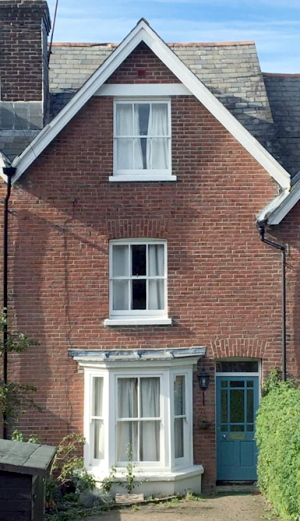
26, Clifton Road, Winchester
– Frank Burgess’ childhood home.
Frank attended Western Infants School, then in Elm Road, before moving on to St Thomas National Church of England Boys’ School in September 1895. He would have remained there until he was 13 or 14 years old.

Frank Burgess's name on the St Thomas School admissions register of 1895
In May 1905 Frank, aged 18, enlisted for 12 years – nine in active service and three in the Reserve - with The King’s Royal Rifle Corps (KRRC). On his enlistment papers he put his prior occupation as ‘porter’ and was recorded as being 5ft 8in tall, weighing 9st 6lbs, and of ‘good physical development’. Frank was posted to the 1st Battalion, The King’s Royal Rifle Corps on 7 September of that year.
The 1st KRRC had served in South Africa during the Boer War. When that ended, they moved to Malta in 1902 and stayed there until 1905 when the battalion was divided into three. Two contingents went to Crete and Cyprus to help the Turkish authorities put down risings. (Until the early 20th Century, it was a key principle of British foreign policy to prop up the Turkish Empire against Russian advances towards the Mediterranean, which, together with the Suez Canal, formed part of the vital British sea route to India.) The third KRRC contingent, which included the Battalion HQ staff, was sent to Cairo. (Egypt was in theory independent but still technically part of the Turkish Empire and was under strong British influence to protect the Suez Canal.) Frank, attached to the third contingent, left the UK for Cairo on 26 September 1905.
In March 1906, the two detachments on Crete and Cyprus re-joined the rest of the 1st KRRC in Egypt. They were on the move from October 1906 onwards, south to Khartoum in the Sudan, where they remained until towards the end of 1907. (That ‘troublesome’ area was then under British and, nominally, Egyptian control.) In 1907 Frank was appointed lance-corporal on 16th January, and was later hospitalised in Khartoum for a time. The 1st KRRC remained in Egypt until January 1909 when they embarked for England, to be stationed at Gosport. Meanwhile his mother Emmeline had died in 1907, aged 45. Frank was promoted to Lance-Sergeant on 18 January 1910, but ended the year by being severely reprimanded for being still in his bed at the Gosport Barracks at 6:45 am.
By 1911 William Burgess, Frank’s father, had become a night-watchman. He had his two younger children at home with him – Reginald, aged 15, was working as a golf caddie, while nine-year-old Edward was at school. William’s sister, Martha Burgess, aged 51, was also living with the family and possibly acting as the housekeeper, since Frank’s younger sister Eva had married in 1910. Eva had probably stepped up to run the household , aged 17, after her mother died in 1907.
Apart from training periods at Wool, Dorset, and Parkhouse Camp in Salisbury, Frank was stationed in Gosport from 1909 until September 1911, when the 1st KRRC moved to Aldershot. They remained there until the outbreak of war in August 1914. From Gosport or Aldershot Frank could easily have visited his family in Winchester.
While at Gosport, Frank met Ethel Hooker and the couple married on 6 April 1912 in St Thomas’s Church, Portsmouth, now the city Cathedral. Ethel had been born to a military family in Dover, Kent, in 1889. She and her five siblings were put into care after their mother’s death in 1891, but they seem not to have been scattered as they were all living in Chelmsford, Essex, as adults. By 1911 – around the time she met Frank - Ethel was in Portsmouth and working as a housemaid at 3, The Parade, HM Dockyard. On 5 November 1912 Ethel gave birth to a son, Frank Richard, always known as Guy, in Farnham, near Aldershot.
In May 1913 Frank extended his military service to 12 years. That August he gained promotion to Sergeant and the following year he further extended his Army service to 21 years. He was described in a 1913 report as ‘a thoroughly capable, hard-working NCO. Has been through a course of mounted infantry. Thoroughly trustworthy and sober’. Ten days after that report, he was absent from 8pm to 10.55pm and subsequently reprimanded.
Great War Record
When war broke out in August 1914, the 1st KRRC were at Aldershot, under the orders of 6th Brigade, part of 2nd Division. The 2nd Division was ordered to France as part of I Corps, led by General Sir Douglas Haig. The 1st KRRC left Salamanca Barracks, Aldershot, at 3.30am on 12 August, entrained at Farnborough and arrived at Southampton at 9am. They sailed at noon in a converted cattle ship and disembarked at Rouen the following day.
Before going into action, the 1st KRRC encamped near Hannappes with the rest of the 6th Brigade. On 21 August ‘in the hottest of weather’, the battalion advanced towards the Germans with the rest of the Brigade and two days later took part in the Battle of Mons, the first British military action of the war.
At Mons, the British Expeditionary Force (BEF) joined the French army in attempting to halt the German advance on Paris. However, the stand soon turned into a retreat when the French unexpectedly began to withdraw, leaving the British no choice but to pull back as well to avoid being outflanked. The retreat was a disciplined one with 1st KRRC in the rearguard. The withdrawal lasted from 24 August until 5 September, but the objective was achieved: the Germans were stopped within 20 miles of Paris.
The KRRC Chronicle of 1914 contains a detailed account of the 1st Battalion’s engagement with the Germans at the Battle of the Marne. The battle, which would save Paris, opened on 6 September with a British and French counter-attack which forced the Germans to retreat. The 1st KRRC, part of an advance guard, pursued the Germans northwards, crossing the River Marne on 9 September. The following day the battalion arrived at the southern end of the village of Hautesvesnes, where they caught up and then attacked a 1,200-strong German rearguard battalion. After some tough fighting, the Germans surrendered. They explained later that the 1st KRRC’s skirmishing and marksmanship were so good that they could neither move nor return fire. In those early weeks of the war, before the advent of trench warfare, the riflemen’s traditional skills of ‘fire and movement’ stood them in good stead. The encounter cost the 1st KRRC 14 men killed and 60 wounded with some men missing.
From the Marne, the German army retreated northwards pursued by the Allies until they reached the heights on the east side of the River Aisne. It was here that Frank next saw action between 13 and 27 September at the Battle of the Aisne. Late in the evening on 13 September, the BEF crossed the river under cover of a thick mist. Fierce fighting ensued over the following days with heavy losses on both sides. The Germans could not push the British back over the Aisne and the British could not push the Germans off the heights. The stalemate led to both sides digging in – trench warfare had begun. The 1st KRRC suffered 149 casualties in the battle, including 27 men killed and eight missing. Three more men were killed and 11 wounded on 28 September when a shell exploded in a trench north of Verneill.
The BEF’s final major encounter of 1914 was the First Battle of Ypres, which opened on 19 October. Frank Burgess was wounded in action near Zonnebeke on 26 October and admitted to the 6th Field Ambulance the following day. He died of the bullet wounds to his left leg and foot on 28 October, aged 26. (The previous day, Prince Maurice of Battenburg, Queen Victoria’s youngest grandson and a Lieutenant in Frank’s battalion, was killed in action while fighting at Zonnebeke. A memorial tablet to Prince Maurice - and his brother Leopold who died in 1923 - stands in the south presbytery aisle of Winchester Cathedral.)
Family after the Great War
Shortly after Frank’s death his widow Ethel and son Frank Jnr (Guy) moved to Chelmsford. Her address on the Imperial War Graves Commission form organising the inscriptions to be put on graves is given as Chale, 34, Henry Road, Chelmsford, which was her father’s home. Another of Ethel’s sisters was also living in the house, with a third at No. 35. Besides her husband, Ethel lost two brothers in the war.
The Winchester War Service Register gives rather confusing details about Frank’s military service. It states, for example, that he was ‘believed killed in action at Mons’ when we know from Commonwealth War Graves Commission records that he died of wounds nearly two months later. The details were almost certainly supplied by Frank’s father in Winchester and, depending on how much contact he had with Ethel Burgess, Frank’s widow and legal next-of-kin, he may have been uncertain as to where and when his son died. The Register gives Frank’s address as 10, Ashley Terrace, Winchester, and although there are no Burgesses listed in Warren’s Directories as living at that address before, during or after the war it is possible that his father William was lodging there. However, in the absence of any clear indication of when William may have moved to 10, Ashley Terrace, this study has chosen to give Frank’s address as 26, Clifton Road, a house he knew well.
Frank’s father, William, left 26, Clifton Road shortly after the 1911 Census. However, with so many Burgesses living in Winchester and more than one with the initial W it has not yet been possible to pin down where he moved to. Nor is it known when he died.
There is also a mystery as to whether Frank’s younger brother, Reginald, served in the Great War or not. He was born in 1895 and therefore of military age during the war and single. No certain military record for him has yet been found. According to the WWSR 1921, the only Reginald Burgess who served in the war, (and who lived at the then 54 Sussex Street, Winchester), enlisted in 1910 in the KRRC. Frank’s Reginald would have only been 15 then and besides he was listed at being at home at 26, Clifton Road in the 1911 Census and working as a golf caddie. Reginald married in 1923. In the 1939 National Register he was listed working as a domestic gardener and living in Farleigh Wallop, near Basingstoke, with his wife Ellen and son Gerald who had been born in 1925. Reginald died in Basingstoke in September 1973, aged 78.
Frank’s older sister, Alice Maud, had married Lewis Jones, a house carpenter, in 1905 in Winchester, By 1911 they were living at 6, Boscobel Road where they remained until 1922. Lewis Jones is in the WWSR 1922, having been a sapper in the Royal Engineers. His service dated from 10 May 1915 and he was invalided out from Chatham, Kent, on 22 June 1918. He was given a Silver War Badge to denote his honourable discharge. By 1923, Alice Maud and Lewis were living on the new council housing estate at 101, Stanmore Lane. For the first two years, Alice Maud’s brother, Edward Silas was living with them. They were there until at least 1927. In the 1939 Register, they were at 3, Fairfield Road and by the 1950s, they were at 5, Cranworth Road. They appeared to have never had children. Lewis died in 1963 at St Paul’s Hospital, changed from its original purpose as the Union Workhouse. Alice Maud was to die in the same place in June 1967. She left her estate of £1,609 to her brother Reginald Burgess.
In 1910 Frank’s younger sister Eva married George Alborough in Winchester. George was a career soldier who had been born in Carlow, Ireland, in 1884. His home address was given in his military records as 3, Greyfriars Terrace, Winchester. He rose to be a Sergeant in the 3rd KRRC and in 1911 he and Eva were living at the overseas military unit at Dagshai, India. George was killed in action at Ypres on 3 February 1915. In 1917 Eva joined the Women’s Army Auxiliary Corps (formed that year to make better use of women labour within the armed forces and free up men for the frontline) and she was stationed at Colchester, Essex, where there was a large military hospital. It may be that having lost two close family members she wanted to ‘do her bit’ for the war effort. It is unlikely that she and George had had children. In 1919 Eva re-married in Winchester, this time to George J. Hunter. She died in Greenwich, south-east London, on 30 November 1964, aged 74.
Little is known about Frank’s youngest brother, Edward Silas, born in 1903. He was living at 101 Stanmore Lane with his sister, Alice Maud, and her husband, Lewis in 1923 and 1924. He and his wife Mabel were listed in the 1939 Register, when they were living at 30, St. Catherine’s Road, Winchester, and he was working as a builder’s lorry driver. Edward died in the city in 1959, aged 56.
Medals and Memorials for Frank Ernest Burgess
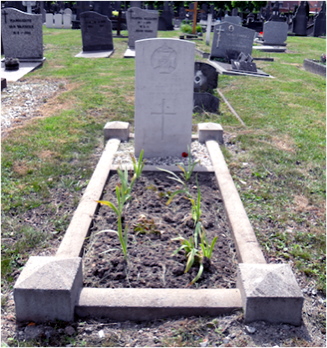
Grave of Frank Burgess at Ypres Town
Cemetery (Photo: Andrew J. Begent)
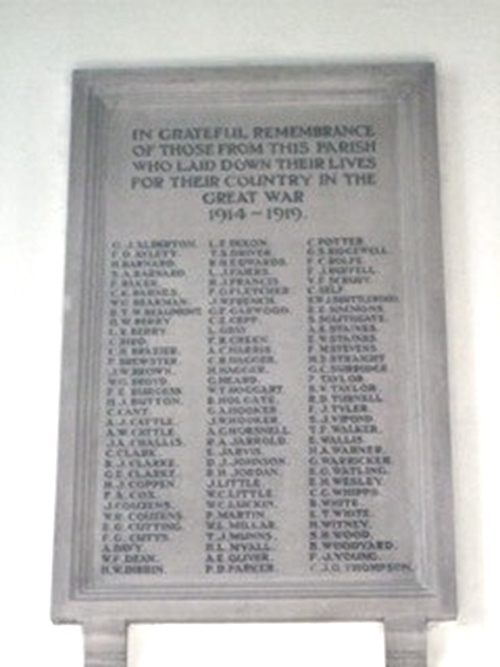
Chelmsford Cathedral War Memorial
Sergeant Frank Ernest Burgess was entitled to the 1914 (Mons) Star, the British War Medal and the Victory Medal. He is buried at Ypres Town Cemetery, Ypres, West Flanders, Belgium (GR. C. 1.) and his headstone is inscribed with the words:
GONE BUT NOT FORGOTTEN.
He is mentioned on the memorials at St Matthew’s and St Paul’s churches, Winchester, and also on Chelmsford’s parish memorial in the Cathedral and on a bronze plaque in the Chelmsford Civic Centre.
Additional sources
- Andrew J. Begent
http://www.chelmsfordwarmemorial.co.uk/first-world-war/chelmsford/burgess-frank-ernest.html