

Private PERCY GEORGE BREADMORE
188, Stockbridge Road, Winchester
Service numbers 3388 and 37641. 2/4th Battalion, The Royal Berks Regiment
Killed in action, France, 28 April 1917
Life Summary
Percy George Breadmore was born in Stockbridge on 3 June 1894, the only son of Albert and Ada Breadmore. Percy’s connection with Winchester came through his uncle, a prosperous corn merchant who lived on Stockbridge Road. It was this address that Percy used when he joined the Army in November 1914. Percy died in April 1917 on the Western Front. His uncle and nephews all served in the Great War and survived.
Family Background
The Breadmores were a well-known family in the Stockbridge area. Percy’s grandfather, George (1828-1893), worked as a maltster in the nearby village of Wherwell before moving to Stockbridge where he established a corn merchant business. Percy’s father, Albert, was born in Wherwell and went to school in Andover. He later set up a coal merchant business in Stockbridge.
Percy’s mother was born Ada Bryant in Islington, north London, in 1868. She and Albert married in Lambeth, south London, in 1890 by which time Albert had started his Stockbridge coal business. Ada gave birth to Percy in 1894 but she died in Lambeth the following year, aged 27. Albert died in 1898.
With his grandparents also dead, it is not clear who looked after Percy in his early years. The next record of him comes in 1901 when he was seven years old and living with bricklayer John Froud and his wife Sarah at their home at Greenhill View, Owslebury, near Winchester. It is not known whether Percy was related to the Frouds. By 1911 he was living at 9/10 North Street, Chichester, West Sussex, and working as a draper’s assistant.
Percy’s uncle Charles Breadmore ran a successful corn merchant business at 120, High Street, Winchester. Charles had been born in Stockbridge in 1869 and by 1901 he was married with five children. One of them, Reginald, was the same age as Percy. Charles was also an award-winning sweet pea grower and he named several new varieties.
By 1914 Charles Breadmore, along with his wife Beatrice and their younger children, had moved to Sunnyside, 188, Stockbridge Road (the address, then and now). This is the address that Percy used when he enlisted in Reading with the 2nd Battalion, The Royal Berkshire Regiment in November that year. His service number was 37641.
Great War Record
Army records show that Percy later transferred to the 2/4th Royal Berkshires with the service number 3388. Although we do not know when he switched, the fact that Percy did not serve overseas until 1916 indicates that it was quite soon after he joined up.
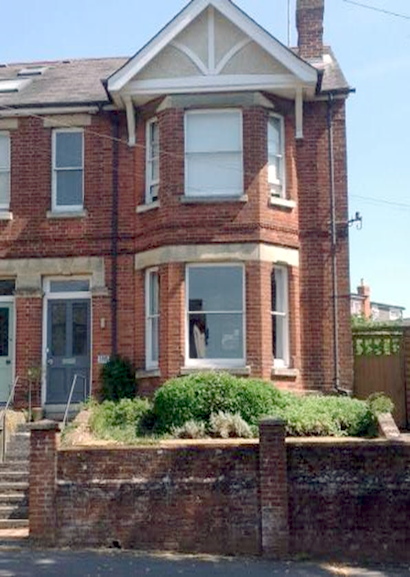
188, Stockbridge Road, Winchester – the home of Percy Breadmore’s
uncle, Charles. Percy gave this address when he enlisted in 1914
The 2/4th Royal Berkshires were a Territorial battalion raised at Reading on 6 November 1914, around the time that Percy enlisted. The battalion came under the orders of 2nd South Midland Brigade, later part of the 61st Division. After training at Maidenhead, Northampton and Chelmsford, the Division moved to Salisbury Plain in March 1916 before departing for the Western Front two months later.
The 61st Division first saw action on 19-20 July 1916 in a joint assault with the 5th Australian Division against German positions at Fromelles. Planned as a diversionary attack to draw German troops away from the Battle of the Somme, which was raging some 40 miles to the south, it proved a disaster. The British and Australians suffered 7,080 casualties in just one day. Such was the damage to the 61st Division and its reputation that it was not used again other than for holding trench lines until 1917.
According to the Winchester War Service Register (WWSR), Percy Breadmore was wounded in August 1916. However, the battalion was not in action that month, so it is possible that he had been wounded at Fromelles.
The 61st Division returned to action during operations on the River Ancre between 11 and 13 March 1917. During this period, the Germans withdrew from the positions they had defended so ferociously during the Somme Offensive to new, even more formidable, defences known as the Hindenburg Line. The 61st was one of the Divisions that cautiously pursued the retreating Germans, capturing the towns of Chaulnes and Bapaume in the process.
Percy Breadmore was killed in action on 28 April 1917 during the Arras Offensive. The WWSR states that he fell while fighting at Gouzeaucourt, near St Quentin, close to the Hindenburg Line. He was 23 years old.
Family after the Great War
Charles Breadmore, Percy’s uncle, served with distinction during the war. Commissioned as a Lieutenant in the Royal Army Service Corps (RASC) in November 1915 at the age of 46, he served in France, Belgium and Italy and reached the rank of Staff Major. He was mentioned in dispatches three times.
Charles’s three sons, Percy’s cousins, also served. Cyril Breadmore was commissioned in October 1914 as a 2nd Lieutenant in the RASC (Mechanical Transport) and reached the rank of Captain. He served in France and Belgium and was twice mentioned in dispatches. Reginald Breadmore also won a commission with the RASC in October 1914. He served in Egypt and Salonica, possibly with the Indian Army, reaching the rank of Major. Douglas Breadmore appears to have moved to Australia before the war because he joined the Australian Imperial Force in Belmont, Western Australia, in November 1914. He fought in France and Belgium and was wounded three times. He was a Sergeant when the war ended.
After the war, it appears that Charles and Beatrice Breadmore divorced. The 1925 Warren’s Winchester Directory shows Beatrice living at 2, Step Terrace, Winchester. She died in 1943. In 1939, Charles was the proprietor of a private hotel in Uckfield, Sussex, with his second wife, Lilian, the manageress. After a remarkably varied and full life, Charles died in Crowborough, Sussex, in June 1960, aged 91.
Reginald Breadmore continued his military career after the war and was appointed the Indian Army’s Chief Inspector of Mechanical Transport in the 1920s. Awarded the OBE, he was promoted to Lieutenant-Colonel in the Indian Army Ordnance Corps (AOC). Reginald died at sea, aged 57, while on active service on 29 March 1941. He is buried at New Sandwick Cemetery, Sandwick, Shetland.
Medals and Memorials for Percy George Breadmore
Private Percy George Breadmore was entitled to the British War Medal and the Victory Medal. He is buried at Villers-Guislain Communal Cemetery, Pas De Calais, France (GR. B. 10), and is mentioned on the memorials at St Matthew’s and St Paul's churches, Winchester.