

Company Quarter Master Sergeant ANDREW WILLIAM BOGIE
2, St Paul’s Terrace, Winchester (20, St Paul’s Hill today)
Service numbers 4/149 and 200023. 1/4th Battalion, The Hampshire Regiment
Died in captivity, Turkey, 22 September 1916
Life Summary
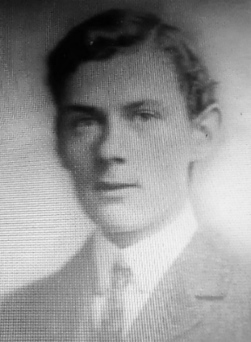
Andrew William Bogie
Andrew William Bogie, the son of Peter and Catherine Bogie, was born in 1882 in St Peter Port, Guernsey. Andrew moved to Winchester in the early 1900s to train to be a teacher and after qualifying he taught at St Thomas Church of England Boys’ School. Married with one son, he joined the Hampshire Regiment’s 1st Volunteer Battalion which later became the 4th Battalion, The Hampshire Regiment. During the Great War, he served in India and Mesopotamia and died of disease while in Turkish captivity after being taken prisoner following the siege of Kut-al-Amara in 1916.
Family Background
Andrew’s father was born in Marwick, Fifeshire, in 1852, and worked for most of his life as a gardener – both domestic and as a market garden trader - in Scotland and England. Andrew’s mother was born Catherine Webb in Malta in 1857 and was known as Kate. Her father, William Webb, was a soldier with the 1/21st (Royal North British Fusiliers) Regiment of Foot, later the Royal Scots Fusiliers. The regiment had arrived in Malta from the Crimean War in June 1856, shortly before Kate’s birth, and remained on the island until March 1860. It was stationed at Fort Ricasoli and formed part of the British garrison.
The 1871 Census listed Kate, then 14, as a scholar at the Royal Victoria Patriotic Asylum for Girls in south-west London. Paid for through public donations and opened in 1859, the Asylum educated and trained 300 orphan daughters of soldiers and sailors who had died in the Crimean War. Clearly William Webb was not killed in Crimea because he was with his regiment on Malta when his daughter was born in 1857. When he did die is unclear.
On 27 December 1880, Peter Bogie and Kate Webb married in Croydon, Surrey, where she was living at the time. The marriage certificate gives Peter’s place of residence as St Andrew, Guernsey, and the couple were recorded as living on the island in the 1881 Census just a few months later.
Following Andrew Bogie’s birth in 1882 Peter and Kate went on to have another son, Alfred, born in Guernsey in July 1884, and a daughter, Catherine, born in Bracebridge, Lincolnshire, in April 1886. Census records show that they also had two other children who died.
The family moved around the country a great deal as Peter Bogie sought work. In 1891 they were living at 58, Lansdowne Road, Croydon, with Peter employed as a gardener/domestic servant. By 1901 they had moved back to Guernsey, with Peter working from home as a self-employed fruit grower. Andrew, by then 19, was a schoolteacher although he had received little or no training. Meanwhile Alfred, following in his father’s footsteps, was working as a gardener.
In 1902 Andrew enrolled at the Diocesan Training College, now the University of Winchester, where he underwent two years of formal teacher training. The college magazine states that Andrew was a regular speaker at debates, including one that asked, ‘Would conscription be beneficial to the country?’ He played for the college reserves football team and was part of the Volunteer Company of the Hampshire Regiment that all students were obliged to join, quickly winning promotion to corporal. Andrew qualified in 1904 and became a master at St Thomas Elementary Boys’ School, the college’s Practising School in Winchester. He was a member of the National Union of Teachers.
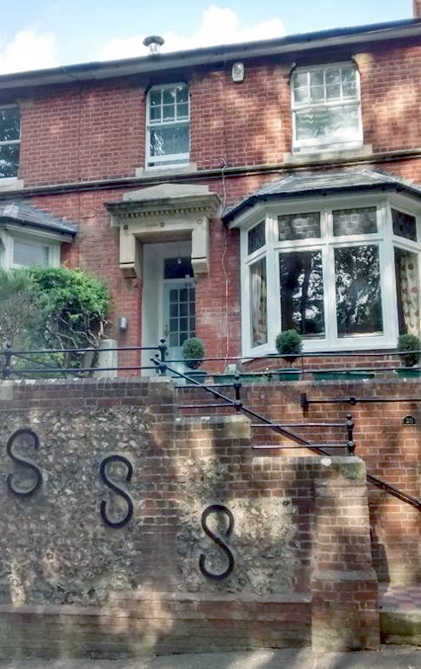
20, St Paul’s Hill, Winchester – this house was 2, St Paul’s Terrace
in October 1914 when Andrew Bogie went to war
In 1910 Andrew married 23-year-old Florence Hannah Moss in her hometown of Great Yarmouth, Norfolk. The 1911 Census showed the couple living at 11, Highfield Villas, St Cross Road, Winchester, but by 1913 they had moved to 2, St Paul’s Terrace. The house was renumbered 20, St Paul’s Hill (the address then and now) during the Great War and is the address given for Andrew in the Winchester War Service Register (WWSR). On 23 February 1913 Florence gave birth to a son, Kenneth, probably at the family home in St Paul’s Terrace.
Living next door to the Bogies at 3, St Paul’s Terrace in 1914 were Ernest and Charlotte Fifield and their son, Jack, who was to be killed while serving with the Hampshire Regiment in the Great War. A few houses further up the hill at No. 10 lived Eric Rule who served in the same battalion as Andrew Bogie. He would die in 1916 during an attempt to rescue Andrew and other Hampshire soldiers trapped in the besieged British garrison at Kut-al-Amara.
Great War Record
Andrew Bogie continued serving as a part-time soldier with the 1st Volunteer Battalion of the Hampshire Regiment until 1908 when the Territorial Force came into being and the unit was redesignated the 4th Battalion, The Hampshire Regiment. His original Army service number (4/149) shows that he transferred to the 4th Hampshires in May 1908. By 1914 he had reached the rank of Sergeant serving in his battalion’s B Company. When the 4th Battalion split into two in September that year Andrew was assigned to the 1/4th Hampshires. He volunteered for service overseas and in October sailed for India.
According to a report in the Hampshire Chronicle of 12 December 1914, Andrew was made Acting Company Quarter Master Sergeant (his responsibilities included ensuring his men were supplied with food, clothing and ammunition) and Orderly Room Sergeant shortly after arriving in India. The 1/4th Hampshires spent just four months there before being sent to Mesopotamia in mid-March 1915. Here they fought several encounters with the Ottoman Turks just north of their base at Basra, including the capture of the town of Nasiriyah on the River Euphrates.
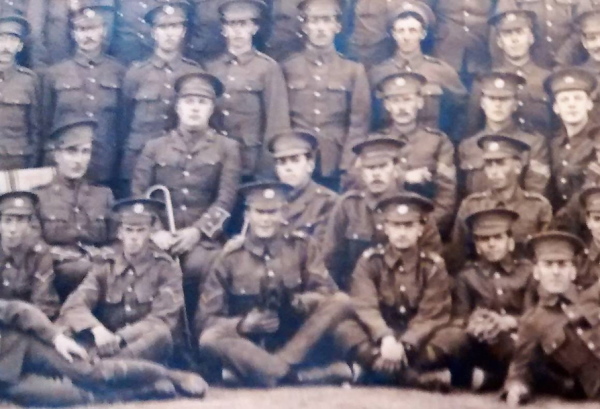
Sergeant Andrew Bogie (third from right second row down) with other
men of B Company, 4th Battalion, The Hampshire Regiment.
The photograph was taken in July 1914, just days before the outbreak of
war, while the battalion was on its annual camp on Salisbury
Plain. (Photo: Royal Hampshire Regiment Museum)
In December 1915, Andrew Bogie found himself among the Hampshire men besieged in the British garrison at Kut-al-Amara (for details of the siege see Siege of Kut). During the five-month siege, Andrew displayed gallantry that earned him the Military Medal – gazetted in 1919 - to go alongside his Meritorious Service Medal. He was also mentioned in dispatches.
After the surrender of the Kut garrison on 29 April 1916, Andrew and the surviving British and Indian soldiers were marched off to prisoner-of-war camps hundreds of miles away in Turkey. The conditions on the march were appalling and many men succumbed to disease. Interestingly, although he had only been in Mesopotamia for a year, Andrew had managed to learn the Turkish language. Evidence of this comes in a letter written by another 1/4th Battalion POW, Regimental Sergeant Major William Leach, who had also been at Winchester Diocesan Training College. In the letter, William describes how a soldier had been flogged and kicked by the Turkish guards during the march into captivity:
[Private Wood’s] belt had been stolen by the escort and his shirt was very much torn. His body was one mass of scars and bruises which he accounted for by the brutal treatment he had suffered. He was flogged and kicked and hit with rifles and was absolutely unable to pick out or recognise the man who had treated him this way owing to his weak condition. I took him with Coy. QM Sgt Bogie (acting as interpreter) to Kashmi Effendi, and showed him how the man had been treated, but owing to the man not being able to pick his assailants no visible sign of notice seemed to be taken.
Andrew eventually reached the POW camp at Yarbaschi in the Amanus Mountains, where those men fit enough worked on the construction of the Baghdad railway. Little is known of Andrew’s short time in captivity at Yarbaschi. Most of the information we do have is contained in the Prisoner of War Comforts Fund records compiled on the Hampshire Regiment POWs by Mrs Esme Bowker, widow of the 1/4th Battalion’s CO. These state that Andrew Bogie was 5ft 10in tall, wore size 9 boots and a six and three-quarters cap. His adopter in England was a Mr Stillwell of The Pines, Windlesham, Surrey, who sent him aid parcels containing a jacket, overcoat, trousers, cardigan and socks as well as a Christmas parcel with plum pudding, sweets, a pipe, cigarettes, soap and other items.
Unfortunately, Andrew probably never received any of these parcels because on 22 September 1916 he died of dysentery, aged 34. New of his death did not reach England for more than a year. The Hampshire Regimental Journal of October 1917 states:
QMS Bogie - Official information has this week been received that QMS Andrew William Bogie, Hampshire Regiment, died of dysentery while a prisoner of war at Yarbaschi, Turkey. This news corning after a long period of suspense is very painful, and much sympathy will he expressed with his wife, who resides at No. 1, St Paul's Terrace. Winchester.
The late QMS Bogie joined the Hampshire Territorials in May 1908 and went out with the Battalion to India early in the war, subsequently proceeding to Mesopotamia. He was in Kut at the time of General Townshend's surrender. For … something approaching twelve months his wife had not heard from him, nor could tidings he gleaned from any other source. QMS Bogie was one of the best-known NCOs of the Battalion, and always enjoyed the highest confidence of his officers, and the warmest esteem of his fellow non-commissioned officers and men, by all of whom he has, no doubt, been greatly missed. In civil life he was an assistant master at St. Thomas Boys' School, Winchester, the Headmaster of which on Thursday afternoon communicated the sad intelligence to the pupils.
Family after the Great War
The Army Registers of Soldiers’ Effects 1901-29 shows that the War Office paid £32 4s 3d to Florence Bogie on 27 March 1918, in respect of Andrew’s effects and back pay. She also received payments of £12 in October 1919 and £4 in April 1920 which were possibly war gratuities. Probate records reveal that she received £137 19s 11d from her late husband’s estate in February 1918.
The Warren’s Winchester Directory of 1918 records Florence living at 22, St Paul’s Hill. The houses in St Paul’s Terrace were renumbered during the war, with No. 22 corresponding to the old 1, St Paul’s Terrace (next to the church). It therefore appears that Florence had moved to the house next door - this tallies with the address given for her in the Hampshire Regimental Journal report above. The Electoral Register of 1920 shows a William Coates also living in the house – perhaps he was a lodger – but Florence was on her own again by the following year.
At some point after 1911, Andrew’s parents moved to Winchester. They were living at 100, Cromwell Road, on the new estate at Stanmore, from 1923 until Peter Bogie’s death in 1925, aged 73. Andrew’s mother subsequently moved to Aldershot and she passed away in Winchfield Hospital on 20 February 1938 at the age of 81. Florence Bogie was still living at 22, St Paul’s Hill when she died on 16 May 1932. She was buried at West Hill Cemetery, Winchester. The inscription on her gravestone, which has since been removed, read: ‘In ever loving memory of Andrew William Bogie who entered the higher life at 34 when in his country’s service and of Florence his wife who re-joined him May 16 1932 age 44 years’.
Florence left her estate, valued at £597 14s 5d, to her son Kenneth who went on to marry Hazel Gladys Clark in the New Forest in 1935. Kenneth worked as a branch manager for an insurance broker and he and Hazel had two daughters and a son. Kenneth died in Salisbury in 1999 and Gladys in 2004. Andrew’s sister Catherine, who in 1911 had been working as a schoolteacher on Guernsey, married widower William Tanner, a 55-year-old builder, on 24 May 1922 in Grayshott, Hampshire. She is believed to have died in Surrey in 1955, aged 69.
Alfred Bogie, Andrew’s brother, joined the 2nd Battalion, Seaforth Highlanders as a professional soldier sometime after 1901. During the Great War he fought as a Private on the Western Front from August 1914 before being transferred to the 1st Garrison Battalion, Seaforth Highlanders. He is believed to have served with them in Salonika from 1916-1918. Alfred was entitled to the 1914 (Mons Star), the British War Medal and the Victory Medal. He later emigrated to Canada and lived in Toronto where he married Mabel Polley on 12 December 1930. However, the marriage was short-lived, Mabel dying in 1932. It is believed Alfred continued to live in Toronto up to his death on 1 December 1972, aged 88.
Medals and Memorials for Andrew William Bogie
Company Quarter Master Sergeant Andrew William Bogie was entitled to the 1914-15 Star, the British War Medal and the Victory Medal. After the war, his body was disinterred and reburied at Baghdad (North Gate) War Cemetery, Iraq (GR. XXI. R. 21.). Andrew’s name appears on the memorials at St Paul’s and St Matthew’s churches as well as those in the Winton Memorial Room at the University of Winchester’s King Alfred College Campus Old Chapel (the former Diocesan Training College) and the St Thomas Church of England Boys’ School Memorial, now at Kings School, Winchester. His name also appears on the memorial in St Peter Port, Guernsey, the town of his birth.