

Acting Corporal JESSE BIGNELL
34, Stockbridge Road, Winchester (no longer stands)
Service Number 16309. 2nd Battalion, The Essex Regiment
Killed in action, Belgium, 8 October 1917
Life Summary
Jesse Bignell’s birth in Longstock, near Stockbridge, was registered in the first quarter of 1883, so he could also have been born in late 1882. He was the eldest child of Thomas and Louisa Bignell. His father had been born in March 1859 in Easton, near Winchester, where Jesse’s paternal grandfather Henry was working as an agricultural labourer. Henry and his wife Sarah already had four daughters, all born when they lived in Kings Worthy, near Winchester. Sarah was about 44 when she gave birth to Thomas. Jesse’s father appears to have worked with horses all his life. He had moved to Winchester by 1881, working as a groom and living in lodgings at 83, Cheesehill Street (now 36 Chesil Street). The householder of No.83 was Charles Whitcher who later moved to Avenue Road, Fulflood, with his wife Ann. Edwin Whitcher, the couple’s son, later died in the Great War and he is commemorated on the Fulflood and Weeke memorials. Edwin Whitcher’s biography.
Family Background
Living at 4, Cheesehill Street (now 2, Cheshil Street) in 1881 was Louisa Brock who worked as a cook to the Shenton family, a name well-known in Winchester. Louisa was the daughter of David Brock and Sarah (née Webb) and had been born in Longstock in around 1859. Romance flourished in Cheesehill Street and she and Thomas Bignell married in Winchester in 1883.
By 1884, the couple must have been living in Winchester as all their subsequent three surviving children were born there. In 1891 Thomas and Louisa were living at 5, Lower Stockbridge Road (now 10, Stockbridge Road) with their four children – Jesse, by then aged eight, Ethel, aged seven, four-year-old Leonard, and William, aged 19 months. William had had a twin Harry who died in early 1890. The elder three children were listed as scholars. Thomas, their father, was working as a stableman to a butcher. The Bignell’s home was a large property and it must have been part of their financial plan to take in lodgers when they started to rent it as, in 1891, there were four lodgers living with the family.
By 1901, Thomas and Louisa and their four children were living at 17, Lower Stockbridge Road, a much smaller property. It was part of a terrace of houses, which has subsequently been demolished, and which stood at right angles to the rest of Lower Stockbridge Road. It would have been overlooked by the Victorian gasometer off Andover Road. This terrace when first built was numbered 9-18, Lower Stockbridge Road. When the road was renumbered and renamed it became 18-36, Stockbridge Road. The access, which now leads to a private car park, was between what is now Haywards Guitars, 38, Stockbridge Road (which was 19, Lower Stockbridge Road) and 16, Stockbridge Road (previously 8, Lower Stockbridge Road.) After the terrace was demolished, Stockbridge Road was not renumbered so the gap in the numbers remains to this day.
The 1901 Census shows that three of the four Bignell children were working. Jesse, by then 18, was a grocer’s porter, Ethel’s occupation was described as ‘nursemaid domestic’ and Leonard, aged 14 was a milk boy. Presumably the youngest, William, aged 11, was still at school. By the time of the 1911 Census, most of the Bignell family were still at 17, Lower Stockbridge Road with Thomas working as a butcher’s stableman, Leonard as a milkman and William as a boot repairer. Jesse, however, was recorded working as a grocer’s assistant in Abridge, near Romford, Essex, in the household of Alfred Bayle, a grocer, and presumably his employer.
Great War Record
Some confusion surrounds which battalion of the Essex Regiment Jesse served with during the Great War. The records of the Commonwealth War Graves Commission state that he was with the 10th Battalion but his Medal Index Card and Army casualty records both list him with the 2nd Battalion. In this case, it has been decided to follow the Army records and assume that Jesse enlisted with the 2nd Battalion in Warley, the main regimental depot in Essex, in December 1914.
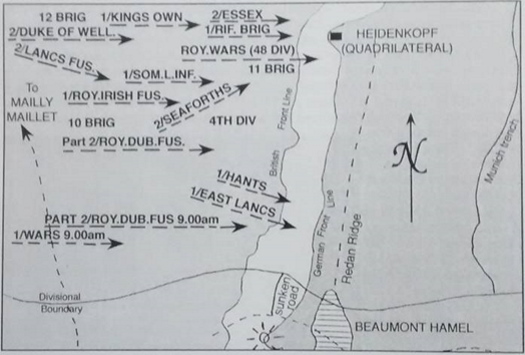
The attack by 4th Division on 1 July 1916, the first day of the Battle of the Somme.
Jesse Bignell’s battalion, the 2nd Essex, are on the extreme left of the British line
The 2nd Essex was a Regular Army battalion under the command of 12th Brigade, part of the 4th Division. The Division had moved to France at the end of August 1914 and fought at the battles of Le Cateau, the Marne, the Aisne and Armentieres that year. In 1915 it suffered heavy casualties at the Second Battle of Ypres (22 April-25 May) which saw the first use of poison gas and flamethrowers in the war. Jesse is recorded joining the 2nd Essex in France on 25 May 1915, the last day of the battle, probably as a much-needed reinforcement.
Jesse was with D Company of the 2nd Essex for the start of the Somme Offensive (1 July-18 November 1916 – Somme). The attack by 4th Division on German positions north of the village of Serre on 1 July proved a disaster. Losses for the day amounted to 5,752, more than half its fighting strength. Jesse’s battalion somehow managed to reach Munich Trench (see map above) despite heavy German machine-gun fire. However, enemy counter-attacks meant these gains had to be abandoned and by the following day the men of 4th Division were back in their own trenches.
The shattered 4th Division did not return to the front line on the Somme until the autumn when it fought at the Battle of Le Transloy (1-18 October). The 12th Brigade went into action at 2.05pm on 12 October when troops attacked Spectrum Trench just to the north of the village of Lesboeufs. The assault, which followed a heavy Stokes mortar bombardment of German positions, was badly hampered by appalling battlefield conditions and made little progress.
At some stage Jesse Bignell was made Acting Corporal which meant he would have overseen 10-15 men. On 13 December 1916 he was taken to Casualty Clearing Station No.34, possibly after contracting trench foot. He was transferred to a sick convoy two days later and may have been sent back to England to recover. Jesse was almost certainly back on the Western Front in time for the Arras Offensive (9 April-16 May 1917, Arras). The offensive opened with the Battle of Vimy Ridge (9-14 April) and the parallel First Battle of the Scarpe – in which 4th Division fought – and saw the biggest Allied successes of the war up to that date. However, the campaign bogged down. The 4th Division also took part in the unsuccessful Third Battle of the Scarpe (3-4 May).
The 4th Division played no part in the opening phase of the Third Battle of Ypres, better known as Passchendaele (31 July-15 November 1917, Passchendaele). However, it did feature in the subsidiary attacks at Polygon Wood and Broodseinde in late September and early October. Using ‘bite and hold’ tactics, with objectives limited to what could be held against enemy counter-attacks, the assaults proved highly successful and dented German morale so severely that they began to make plans to withdraw from the Belgian coast. In the event, the Germans did not need to withdraw: the rain, which had blighted British efforts during the early weeks of the battle, returned after Broodseinde to effectively blunt subsequent attacks.
Jesse Bignell, who had been wounded on 3 September, was killed in action on 8 October 1917, aged 34. He probably died that night as the 2nd Essex moved up the line in torrential rain before going over the top at 5.20am the following day at the start of the Battle of Poelcapelle.
Family after the Great War
Jesse’s youngest brother William also fought in the Great War after enlisting with the 2/4th Battalion, The Hampshire Regiment in August 1914. He served in India for more than two years before transferring to Egypt and then Palestine where he took part in the advance on Jerusalem. In June 1918, the 2/4th Hampshires moved to the Western Front where they swiftly gained a reputation as a formidable fighting unit. William served alongside Henry Churcher, who lived at 3, Avenue Road, Winchester. Henry was killed during this final phase of the war.
After the war, Thomas and Louisa Bignell continued to live at 34, Stockbridge Road. Louisa died in 1934, aged about 75, and Thomas in September 1937. All of Jesse’s siblings married. Ethel married Cornelius ‘Frank’ Hillyer in 1912 in Winchester. Frank went on to serve on the home front in the Great War. Ethel and Frank, who had no children, were living at 11, North Walls, Winchester, in 1939. Ethel died in Winchester in 1952, aged 68.
In the 1939 Register, Jesse’s brother Leonard was a works contractor labourer. He and his wife Sarah were living at 31, Fairdown, Winchester. Leonard died in Winchester in 1955. His youngest brother, William was a clerk at the Records Office and he and his wife Elsie were at 63, Stanmore Lane, Winchester. Both couples appear to have had children.
Medals and Memorials for Jesse Bignell
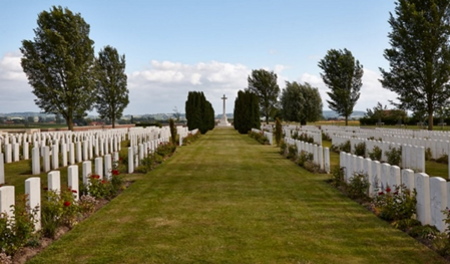
Nine Elms Cemetery
Acting Corporal Jesse Bignell was buried in Nine Elms British Cemetery (above), Poperinge, West Flanders, Belgium (GR. IV. B. 6.). He was entitled to the 1914-15 Star, the Victory Medal and the British War Medal. His name is the first on the memorials at St Paul’s and St Matthew’s churches, Winchester.
Additional sources
- The Essex Regiment: http://www.essexregiment.co.uk